Accidental explosion
It can explode.
EPA says changes in the material's crystals have made it more sensitive to shock and friction. The Army says moving or disturbing it could set it off.
EPA's emergency permit noticeA public petition / Middletown, Iowa
Destroying the explosive
does not destroy the lead.
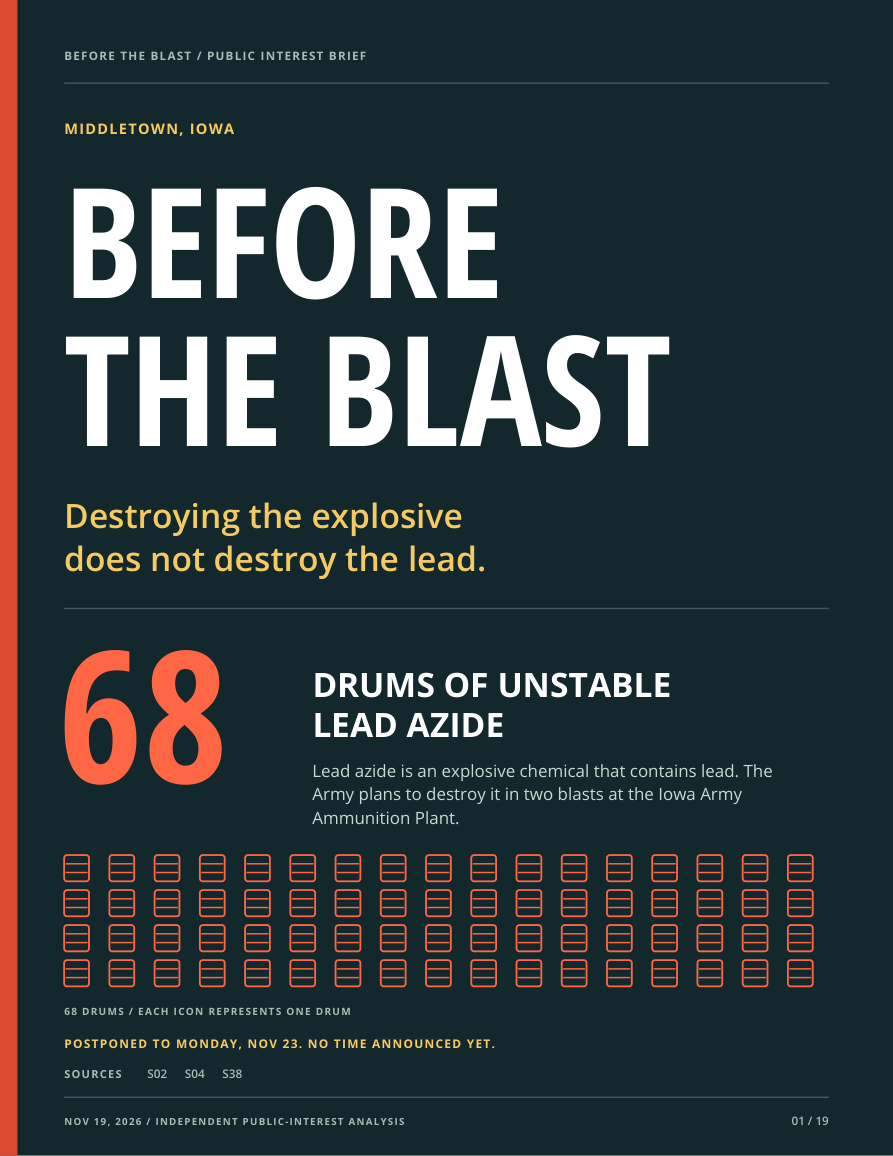
The Army plans to destroy 68 drums of unstable lead azide at the Iowa Army Ammunition Plant. Ask for independent safety review, public testing, clear cleanup responsibility, and a plan to prevent another emergency.
No account needed. Please sign only once. Website display is your choice.
Each icon represents one drum. EPA stockpile record.
Lead azide is an explosive chemical that contains lead.
The Army says it is too dangerous to move. The planned blasts would remove the explosion risk and release some lead-containing dust.
Read the Army's explanationPOSTPONED TO MONDAY, NOVEMBER 23, 2026Moved from November 20 / two controlled blasts. Check the Army's notices for the time.
See the Army's current noticesWhat the public record shows
The explosion risk is serious. So is the need to account for the lead left afterward. A responsible disposal plan must address both.
Accidental explosion
EPA says changes in the material's crystals have made it more sensitive to shock and friction. The Army says moving or disturbing it could set it off.
EPA's emergency permit noticeLead dust and residue
The Army expects a cloud of dust containing lead. The lead that escapes or remains in dust, soil, and debris still needs to be measured and managed.
Army public advisoryThe Army expects barriers, wet soil, and water spray to reduce lead leaving the plant. It predicts that airborne lead may be elevated but well below the level at which EPA would require protective actions.
The permit says the size of that reduction is uncertain. For the public warning maps, it requires the Army to assume that all of the lead is released, so the warnings do not understate the affected area. EPA and Army experts agree those maps may not match actual conditions.
Measurements are needed to establish what actually happens.
Where the dust could go
Middletown is in Des Moines County, Iowa, near Burlington. It is not the city of Des Moines.
The Army has separate maps for lead dust in the air and lead settling on surfaces. The air forecast reaches much farther from the plant than the surface forecast. The direction and reach of both depend on the weather, and the Army is updating the maps until the operation. The records reviewed do not list every county the forecasts reach.
See the Army's current maps and safety instructionsEvidence reviewed through November 19, 2026. These forecasts do not establish contamination at any property.
REMOVE THE EXPLOSION RISK.
ACCOUNT FOR THE LEAD.
Five requests to the Army and EPA
An independent review must weigh the danger of proceeding against the danger of delay. The public also deserves clear answers, reliable testing, and responsibility for any needed cleanup.
Compare the selected method, practical alternatives and the risks of waiting, using qualified explosives-safety and environmental specialists who did not take part in the original decision. Pause only if an assessment shows that a pause would reduce overall risk.
Before any remaining operation, if safely possible
Show where testing occurs, conditions before the blasts, results afterward and the lead levels that require cleanup, with the results checked by reviewers independent of the Army and its contractors. Include potentially affected areas in Iowa and Illinois. Explain the limits of the data.
Before-and-after testing; results as available
Identify who performs and pays for required testing and cleanup. Give residents of Iowa and Illinois one clear process for requesting help, reporting possible damage and submitting claims. Explain who will confirm that the work is complete.
Clear contacts and written responsibilities
Hold a recorded public briefing that takes residents' questions and is followed by written answers. Provide a written response to this petition within 30 days of receiving it.
Written response within 30 days of receipt
Review how the material became unstable, including storage, inspections and earlier disposal choices, without presuming the outcome. Within 90 days of receiving this petition, publish a prevention plan with named responsible offices, deadlines and a schedule for any remaining investigation.
Prevention plan within 90 days of receipt
This petition calls for a documented safety decision. It does not assume that moving the drums or delaying disposal is safe.
Add your name
Support a public, evidence-based decision that protects workers, families, farmland, and water.
Petition signatures
Checking the signature count...
To the U.S. Army and U.S. Environmental Protection Agency Region 7, with copies to public officials serving affected areas of Iowa and Illinois:
We ask for an independent safety review, public environmental results, clear cleanup responsibility and a plan to prevent another dangerous stockpile emergency at the Iowa Army Ammunition Plant near Middletown, Iowa.
1. Have qualified explosives-safety and environmental specialists who did not take part in the original decision, and who do not work for the plant's operating contractor, independently review the selected disposal method, practical alternatives and the risks of waiting. Before any remaining operation, assess whether a brief pause could be managed safely and would reduce overall risk, and pause only if it would. If waiting would increase danger, explain why. Publish the findings, withholding only information that must be protected for security reasons. If the operation has already occurred, review the decision and the earlier storage and handling of the material without delay.
2. Publish the testing plan, baseline conditions and environmental results, and have them checked by qualified reviewers independent of the Army and its contractors. Explain where samples are taken in potentially affected areas of Iowa and Illinois, the limits of the data and the lead levels that require cleanup at homes, farms and public spaces. These requests build on the permit's existing testing, cleanup and reporting requirements.
3. Identify who will perform and pay for required testing and cleanup. Provide one clear route for residents of Iowa and Illinois to request help, report possible property damage and submit claims, building on the Army's existing claims process. Explain who will confirm that required work is complete, and how.
4. Hold a recorded public briefing that takes residents' questions and is followed by written answers. Provide a written response to this petition within 30 days of receiving it.
5. Review how the material became unstable, including storage, inspections and earlier disposal choices. Within 90 days of receiving this petition, publish a prevention plan with named responsible offices and deadlines, plus a schedule for any remaining investigation.
The 30- and 90-day periods are requested commitments, not statements of existing legal deadlines. This petition does not presume negligence, and it does not assume that any particular alternative is safe for these drums. Signatures express support for these requests; technical safety decisions require qualified assessment.
Checking whether this browser has already signed...
Community voices
Comments are published only with permission and after review. Signing does not require a public comment.
Loading community comments...
Read the full public-interest brief
The report examines the disposal plan, the plant's history, possible alternatives, contract records, and who should bear the costs.
Evidence reviewed through November 19, 2026, before the planned operation.
Go to the original records
The source documents distinguish official predictions, requirements, and the questions that remain unanswered.
The detailed requirements for storage, treatment, warnings, environmental testing and cleanup.
Open source documentThe Army has already assessed the operation and considered alternatives. This petition asks for an independent check of that decision.
Open source documentWritten for the original November 20 date: two planned blasts, protective measures and the Army's forecasts. Included maps are dated November 17.
Open source documentPossible effects in Mercer County and requests for testing, shared information and public results.
Open source documentLatest schedule, public precautions and environmental documents. Use this source for current safety instructions.
The reason for the permit, the explosion hazard and requirements for monitoring, cleanup and reporting.
The detailed requirements for storage, treatment, warnings, environmental testing and cleanup.
The Army has already assessed the operation and considered alternatives. This petition asks for an independent check of that decision.
Written for the original November 20 date: two planned blasts, protective measures and the Army's forecasts. Included maps are dated November 17.
The 68 drums, the planned disposal and the roles of the Army and EPA.
The acting Secretary of the Army moved the detonation from November 20 to Monday, November 23, ahead of a forecast temperature drop.
The postponement, the absence of a time for Monday, and the environmental groups' request that a federal appeals court review and pause EPA's permit.
Reports the postponement and, citing an Army spokesperson, describes the material as 68 barrels weighing about 9,700 pounds.
The Army's questions and answers from its open house, including how to file a claim for damage from the detonation.
Written for the original November 20 date: precautions for people in potentially affected areas and advice on blood lead testing.
University of Iowa researchers plan their own air and soil sampling during and after the detonation and say they lack the data behind the Army's maps.
Possible effects in Mercer County and requests for testing, shared information and public results.
Iowa DOT lists Middletown and Burlington in Des Moines County. This is not the city of Des Moines.
The rule EPA cites for emergency permits. The permit says it runs to February 11, 2027 unless EPA terminates it under this rule. Signatures do not automatically cancel it.
Clear answers
Obtain independent safety review, explain the disposal decision, publish environmental testing, make cleanup responsibility clear, and investigate how to prevent another emergency.
The Army has already published an environmental assessment. This petition asks for an independent check of the existing decision, including the risks of both proceeding and delay. It does not assume that an alternative method or a pause is automatically safer.
University of Iowa researchers plan their own air and soil sampling during and after the detonation. The petition asks that the official testing plan and results also be published and independently checked.
Only if it reaches 250 signatures by the end of Sunday, November 22, 2026 (Central time). If it does, it will be sent to the U.S. Army, EPA Region 7 and public officials serving affected areas of Iowa and Illinois as soon as it reaches 250, and signatures added before the deadline will follow in a final list. This page will say when and to whom it was sent.
Signing closes at the deadline either way. If the petition has not reached 250 signatures by then, it will not be delivered, and this page will say so.
A delivered petition includes the petition text and each signer's name, community and signing date. It also includes comments that signers chose to share and that were approved. The 30- and 90-day responses the petition asks for would be counted from the day officials receive it.
Partly. The Army's community fact sheet says people can file a claim against the Army for any damage they believe the detonation caused. Claims are made on Standard Form 95 within two years of the incident, through the Army's claims office at Fort Leavenworth, Kansas (913-684-3564). EPA's permit also requires the Army to carry out cleanup, inside and outside the plant, where it is needed to protect health and the environment.
This petition asks for one clear route that covers testing requests, cleanup, and claims, and for a public statement of who performs and pays for the work.
Yes. Iowa Public Radio reports that on November 19, Earthjustice, on behalf of the Iowa Environmental Council and the Sierra Club's Iowa chapter, asked the 8th U.S. Circuit Court of Appeals to review EPA's November 13 emergency permit. The groups also filed an emergency motion asking the court to put the permit on hold. Because the detonation was then set for November 20, they asked for a ruling by 10 a.m. that day. No ruling had been reported by the evening of November 19.
This petition is separate from that case. It asks the Army and EPA for independent review, public testing, clear cleanup responsibility and prevention.
Iowa Public Radio reportNo. This is an independent public petition based on public records. It is not an emergency-alert service.
Use the Army's website for current advisories and safety instructions.On this website, only if you choose. Your first name, last initial and community can appear with a comment you choose to share, once it is approved. That option is unchecked by default.
If the petition is delivered, your full name and community go to the U.S. Army, EPA Region 7 and public officials serving affected areas of Iowa and Illinois. Petitions sent to government agencies can become public records. This petition does not ask for your email address.
Read the privacy policy.No. You sign with your name. Your browser keeps a private key so you can edit or withdraw your signature later, and you receive a private code to do the same from another device.
Because there is no account check, the count shows entries received. It does not show verified identities. Each browser can sign once, and the number of signatures from one network connection in a day is limited.
Only comments that signers choose to share are considered. They are reviewed before appearing, and not every comment is published. If you keep your name private, an approved comment appears on this website without your name. A delivered petition includes shared, approved comments with the signer's name.
You can edit your choices or withdraw your signature from Manage my signature.
This campaign's evidence was reviewed through November 19, 2026. The Army's forecasts can change with the weather, and this website does not establish conditions at your property.
On November 19 the Army postponed the detonation from Friday, November 20, to Monday, November 23. The acting Secretary of the Army said Monday is the latest possible moment before a forecast temperature drop, which would risk making the material less stable. By the evening of November 19, the Army had not announced a time for Monday or posted an updated advisory.
The Army's November 18 advisory, written for the original date, said maps would be updated six hours before the detonation and every hour after that until it takes place. Check the Army's page for its current advisory, maps and safety instructions.
Iowa's Department of Health and Human Services, in a fact sheet written for the original date, recommends that people in potentially affected areas stay indoors with windows and doors closed for 24 to 48 hours after the detonation, unless updated official guidance says otherwise. Once the airborne exposure period has ended, it recommends wet-cleaning surfaces such as playground equipment, toys and windowsills with soap and water.
The department says blood lead testing is the only recommended way to evaluate exposure, and that anyone concerned should ask a health care provider whether testing is appropriate. Children younger than six and pregnant women are at particular risk.